
PEAT SOILS AS CO2 RESERVOIRS
Soils with over 20% organic carbon – i.e., carbon from dead organisms (mostly plants and microorganisms) – are important for the climate. They cover less than 10% of the world’s land area but store more CO₂ than all the trees on Earth combined.

The image contrasts two peat‑soil cross sections. On the left, a water‑saturated peatland holds a high water table beneath plants; it is carbon‑rich and emits only small amounts of methane from decomposition. On the right, a drained peat soil with drain pipes shows a lowered water table. A tractor sits on the surface; arrows indicate increased CO₂ and nitrous oxide (N₂O) emissions and ground subsidence. A blue vertical double arrow labels “water‑table regulation,” while a black arrow indicates “drainage.” The message: wet peatlands store carbon, whereas drainage dries the soil, releases stored carbon, and boosts greenhouse‑gas emissions.
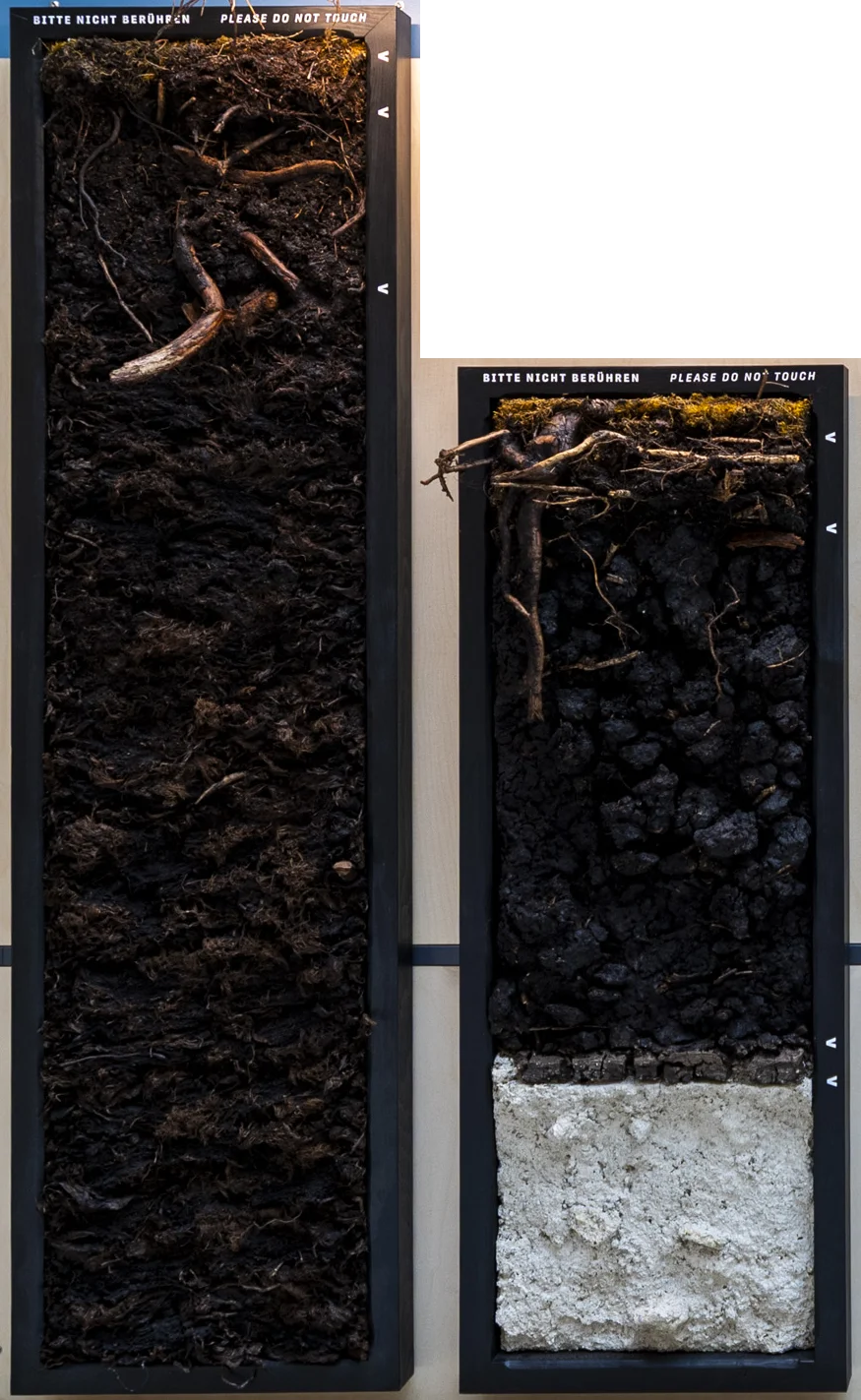
Exhibits in the exhibition. Photo: Nicola Pitaro
Further information about the exhibits
Peatlands are typical examples of organic soils. They consist largely of peat, which is formed from dead plants in permanently wet, low-oxygen environments. Because microorganisms only decompose plant residues slowly under these conditions, the carbon that plants absorbed from the air as CO₂ during their lifetime remains stored in the peat.
If peatlands are drained, for example for agricultural use, the water level drops and the peat dries out. Oxygen penetrates the peat and microorganisms begin to decompose the previously preserved plant residues. In the process, the carbon (C) from the plant residues combines with the oxygen (O₂) to form CO₂, which escapes into the atmosphere. At the same time, the soil sinks – a process which is intensified by compaction due to agricultural tillage.
Rewetting peatlands can reduce the release of greenhouse gases. Decomposition slows down and peat formation restarts, so the soil can once again store more carbon than it releases.
PEATLANDS IN SWITZERLAND
The drainage of peatlands has substantially contributed to global greenhouse gas emissions. In Switzerland, around 90 % of peatlands were drained in the 19th and 20th centuries in order to gain land for agriculture and forestry. This is how the ‘Grand Marais’ in the Bernese Seeland became Switzerland’s vegetable garden. As a result, the ground there sank by up to 2.4 metres in 100 years.
Today, Switzerland is promoting the rewetting of peatlands as a climate protection measure. If the peat soil remains in agricultural use – e.g., for the cultivation of wet rice – it is called paludiculture. If the peatland is returned to a near-natural state, this is known as restoration. Now the peat can build up again. Decades or even centuries can pass before a peatland ecosystem with its highly specialised flora and fauna is fully restored.